
Mau Binh at 50JILI is a popular card game in the Philippines and Southeast Asia, using a deck of 52 cards with 2-4 players. The rules of the game require players to combine card arrangement skills, card allocation tactics and the ability to read opponents’ cards.
Basic rules of Mau Binh
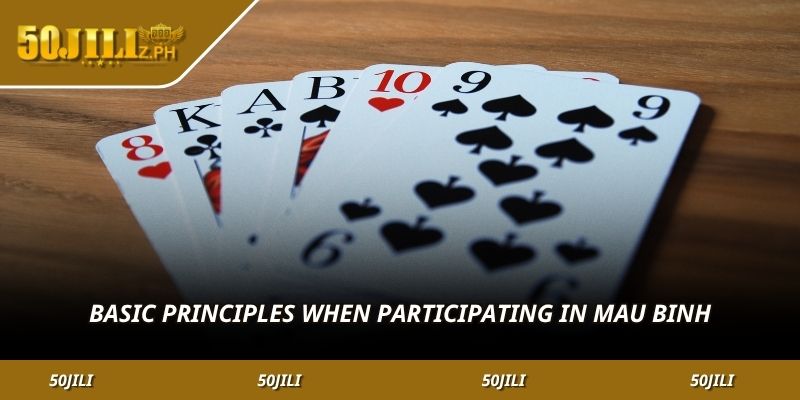
This is a popular card game in Vietnam and Southeast Asian countries, requiring players to arrange cards into reasonable sets. This game combines luck in receiving cards and arranging skills to create the strongest possible hands.
Number of participants and method of distributing the papers
Mau Binh is usually played with 2-4 participants, using a deck of 52 cards, each person receives 13 cards. The card dealing process takes place clockwise, each person is dealt in turn until enough cards are available, creating fairness and randomness in the distribution of cards. Most games are completed in about 15-20 minutes, including the time to arrange the cards.
Method of arranging 13 cards into 3 separate sets
The 13 cards are arranged into 3 hands: hand 1 (bottom) consists of 5 cards, hand 2 (middle) consists of 5 cards and hand 3 (top) consists of 3 cards, with the requirement that the bottom hand must be stronger than the middle hand and the middle hand must be stronger than the top hand. Each hand is compared in order of increasing strength: single card, one pair, two pairs, three of a kind, straight, flush, full house, four of a kind and straight flush, with about 70% of players prioritizing building the strongest bottom hand possible.
Cases of winning in Mau Binh
Winning outright occurs when a player has special hand combinations such as sap (6 pairs), lieng (3 straights), ba cao (3 sets of three), or luc phe (12 consecutive cards). These cases appear with very low frequency, only about 1-2% of the total number of games, but bring large rewards, often 3-5 times the normal winning points.
Particularly rare is the case of a straight flush (5 consecutive cards of the same suit) in the lower hand, appearing in only about 0.3% of games. The owner of the straight flush usually wins overwhelmingly with a rate of 95%. Professional Mau Binh clubs record cases of “dragon roll” (3 cards of the same suit) appearing extremely rarely, about 0.05% of games, and almost always leading to a clean win.
How to calculate points in Mau Binh
Scores are calculated based on the results of comparing each hand between players, with specific rules for adding and subtracting points.
How to compare and contrast each set of hands between players
When comparing, each player compares each hand against all other opponents. Hand 1 (bottom) usually has the highest score, double that of hand 2 (middle) and triple that of hand 3 (top). About 82% of games are decided by the bottom hand, showing the special importance of building a strong hand.
Within each hand, the hands are compared in order from highest to lowest, with a four of a kind being the strongest (accounting for only 0.8% of all hands created). Data from major tournaments shows that winning all three hands occurs in only about 25% of the games, while the majority (60%) are won in two hands and lost in one hand. This illustrates the high level of balance and competition in the game of Mau Binh .
Rules for adding and subtracting points
In Mau Binh , each winning hand is worth points, each losing hand is worth points, with the lower hand usually worth 3 points, the middle hand 2 points, and the upper hand 1 point. The winner of all 3 hands (winning 3) is awarded 3 more points, bringing the total number of points that can be received from an opponent to 9 points. In professional casinos, about 22% of games end with the winner winning 3, creating spectacular reversals.
Special multipliers are applied to strong hands such as straight flush (x5), four of a kind (x4) or full house (x3). Data from popular Mau Binh applications shows that hands with multipliers appear in about 18% of games, creating large score fluctuations. In particular, when the lower hand has a multiplier, the bonus points can be up to 15 points for a hand, completely changing the game situation and creating dramatic moments.
How to deal with a broken army or a total loss
A broken hand occurs when a player arranges his cards incorrectly according to the “weak upper hand, strong lower hand” rule (the upper hand is stronger than the middle hand or the middle hand is stronger than the lower hand). The player with a broken hand automatically loses all hands and must pay double the usual points, equivalent to 18 points for each opponent. Mau Binh clubs record a broken hand rate of about 5% in new players and less than 1% in experienced players.
A complete loss occurs when the opponent has a special hand such as a pair of threes, a pair of threes, or a pair of sixes. The complete loser must pay 3-5 times the normal amount of points, up to 45 points per game. Notably, in major tournaments, professional players who use a “safe play” strategy – prioritizing avoiding losing cards and minimizing the possibility of a complete loss – often achieve 40% better results than risky players.
Conclusion
Mau Binh is not only a simple card game but also a unique cultural and entertainment heritage. With a delicate balance between luck and tactical skills, the game trains logical thinking while bringing unforgettable dramatic moments at 50JILI .